Case 02 · SharingCloud · Workplace management
One product, several surfaces
WorkplaceToBe had to remain a single product while being delivered on several surfaces: web, mobile, Outlook, room displays and desk labels. I led its redesign on the design side by building a shared system, able to adapt the same uses to each context.
- Role
- Principal Product Designer
- Duration
- 2022 – 2025
- Team
- Two Product Owners, three front-end developers, a Scrum Master
- Deliverables
- Multi-surface redesign, design system
- Layers involved
- surfaces (involved)
- design system (involved)
- model (involved)
SharingCloud published WorkplaceToBe, a workplace management platform for booking spaces, declaring office presence and following life on site.
I joined the team in 2022 as Principal Product Designer to lead the redesign with two Product Owners, three front-end developers and a Scrum Master. I also mentored a work-study designer.
A product that had become fragmented
WorkplaceToBe had been built through successive additions. Over time, its interfaces had accumulated different components, behaviours and sometimes technologies.
So the problem was not only visual: without a shared foundation, every new feature or new surface deepened the fragmentation.
I proposed starting with a shared design system, with the support of the front-end developers.
Before
Each addition brings its own components.
- Web
- Mobile
- Outlook
After
Patterns carry the unity, libraries the differences.
- Library Web and mobile
- Library Outlook
- Library Screens and labels
- Patterns book, declare presence
- Components buttons, fields, icons
- Tokens colours, typography, spacing
Starting again from uses
Rather than treating each interface separately, we went back over the product’s main uses:
- Booking: room, desk, parking space, bike or locker.
- Presence: declaring your office days and seeing where your team is.
- News: following life on site.
- Events: seeing what is happening on site.
This reading made it possible to see Outlook, room displays or DeskTags not as standalone products, but as specialised access points to WorkplaceToBe.
Shared objects
The data model already existed on the back end. My work consisted in identifying the objects users actually handled and giving them a consistent representation in the interface.
A booking, a space or a presence had to keep the same meaning, the same vocabulary and the same essential information, whatever the surface.
One use, several contexts
Web and mobile formed the core of the product. The other surfaces only took on the uses relevant in their context.
- Book a room
- Web
- Mobile
- Outlook from the invitation
- RoomPad at the room
- BoxPad
- Book a desk
- Web
- Mobile
- Outlook
- DeskTag occupancy
- Parking, bike, locker
- Web
- Mobile
- Declare presence
- Web
- Mobile
- Outlook
- See your team
- Web
- Mobile
- Outlook
- News
- Web
- Mobile
- Events
- Web
- Mobile
- full use
- information only
A surface missing from the row does not offer that use.
So a feature was not duplicated everywhere on principle. It only appeared where it made sense: booking from Outlook, acting directly at a room, or showing who occupies a desk.
What stays shared, what changes
The design system shared tokens (the named values for colour, spacing or typography), components and interaction patterns. This foundation was adapted into libraries specific to each surface.
Three rules guided these adaptations:
- Objects and vocabulary stay the same.
- Interaction adapts to the context and to the available density.
- A new surface exposes existing uses; it does not recreate the product.
We identified the shared uses, then kept for each surface those relevant in its context. Booking a room from an Outlook invitation and doing it on a RoomPad at the door are the same use, but different situations. The room display was not meant to take on all the day-planning features available on the web.
Result and scope
The new web home brought the main uses together around the employee’s day: their bookings, their team’s presence, events and news from the site.
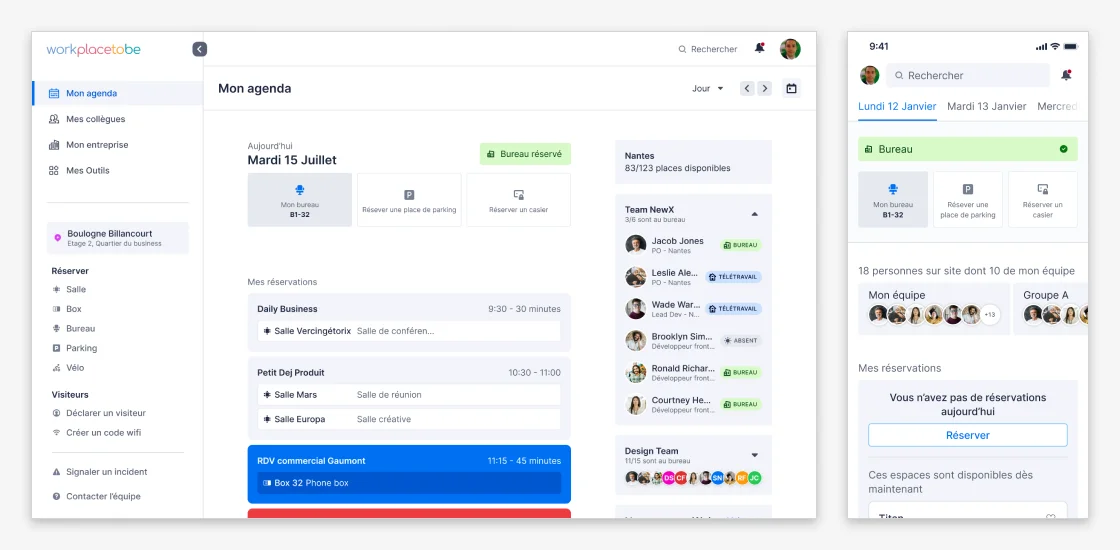
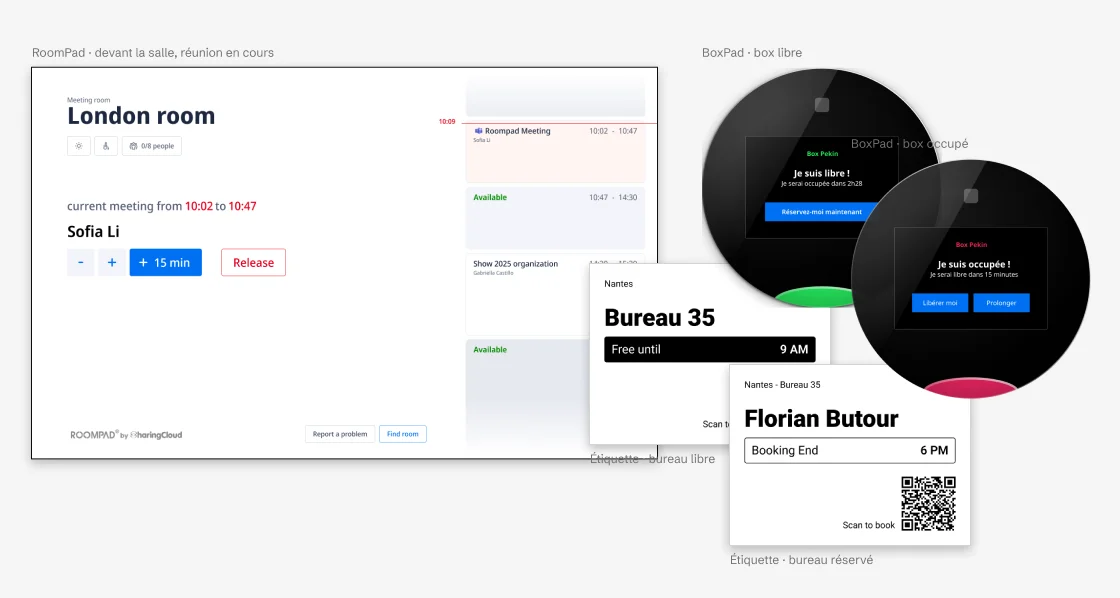
The redesign established a shared framework for evolving the interfaces: shared objects, identified uses and adaptation rules. This framework was meant to limit the decisions revisited for each new surface. The case does not, however, document any measure of design time saved or any comparative evaluation of the experience across surfaces.
SharingCloud was acquired by Witco in June 2024.
This work is representative of how I approach this kind of product: start from uses, stabilise the objects, then adapt their representation to each context.